
Curr Health Sci J, vol. 52, no. 3, 2026
Integrated Clinicopathological Assessment of Endometrial Polyps as Heterogeneous Proliferative Lesions in Reproductive-Aged Women
[Original Paper]
V.T. MOTATEANU(1,2), R.G. CAPITANESCU(3,4), M. OLINCA(5,6), T.A. GEORGESCU(5,7), N.D. OPRESCU(2,8), A.C. COMANESCU(3,4), S. PAITICI(9,10), A.V. TETILEANU(11), N.L. VOICU(2), C. BERCEANU(3,4)
(1)PhD Student, Doctoral School, University of Medicine and Pharmacy of Craiova, Romania;
(2)Department of Obstetrics and Gynecology, “Polizu” Clinical Hospital, “Alessandrescu-Rusescu” National Institute for Healthcare of Mother and Child, Bucharest, Romania;
(3)Department of Obstetrics and Gynecology, University of Medicine and Pharmacy of Craiova, Romania;
(4)Department of Obstetrics and Gynecology, Emergency County Hospital, Craiova, Romania;
(5)Department of Pathology, Carol Davila University of Medicine and Pharmacy, Bucharest, Romania;
(6)Clinical Hospital of Obstetrics and Gynecology “Prof. Dr. Panait Sârbu”;
(7)Department of Pathology, National Institute for Mother and Child Health "Alessandrescu-Rusescu" Bucharest;
(8)Department of Obstetrics and Gynecology, “Carol Davila” University of Medicine and Pharmacy, Bucharest, Romania;
(9)Department of Surgery, University of Medicine and Pharmacy of Craiova, Romania ;
(10)3rd General Surgery Clinic, Emergency County Hospital, Craiova, Romania;
(11)Department of Obstetrics and Gynecology, Emergency County Hospital Târgu Jiu, Romania
Abstract:
Background: Endometrial polyps (EPs) are heterogeneous focal proliferative lesions with variable clinical, ultrasonographic (US), and histopathological features across reproductive age. Objective: To characterize EPs in reproductive-aged women using an integrated clinical, US, histopathological, and immunohistochemical (IHC) approach, with emphasis on age-associated differences. Methods: This retrospective multicenter study included 62 premenopausal women aged 28-49 years with histopathologically confirmed EPs. Participants were equally stratified into Group A (28-38 years, n=31) and Group B (39-49 years, n=31). Clinical, metabolic, US, histopathological, and representative IHC data were comparatively assessed. Results: Abnormal uterine bleeding was significantly more frequent in Group B than in Group A (90.32% vs 41.94%, p<0.001). Group B also showed higher frequencies of irregular cycles, infertility, mixed histological subtypes, and heterogeneous lesion and background endometrial morphology, together with larger lesions and increased endometrial thickness. Glandular crowding was significantly more frequent in Group B (54.84% vs 29.03%, p=0.039), while cystic glandular dilatation, increased gland-to-stroma ratio, nuclear atypia, and disordered proliferative or hyperplastic background endometrium were also more common. Most lesions were solitary and regularly contoured, with a feeding vessel identified in 64.52% of cases. IHC assessment demonstrated loss of PAX2 expression and a high, heterogeneous Ki-67 proliferative index in representative lesions. Conclusion: EPs in reproductive-aged women display age-associated clinical and morphological heterogeneity. Integrating clinical presentation, US morphology, histopathological architecture, and background endometrial features may provide a more comprehensive framework for lesion assessment.
Keywords: Endometrial polyps, reproductive age, endometrial remodeling, ultrasonography, morphological variability, immunohistochemistry.
Corresponding: Razvan Grigoras Capitanescu, Department of Obstetrics and Gynecology, University of Medicine and Pharmacy of Craiova, Romania, e-mail: razvan.capitanescu@gmail.com; Adrian Victor Tetileanu, Department of Obstetrics and Gynecology, Emergency County Hospital Targu Jiu, Romania, e-mail: adi_teti@yahoo.com
DOI 10.12865/CHSJ.52.03.10 - Download PDF Integrated Clinicopathological Assessment of Endometrial Polyps as Heterogeneous Proliferative Lesions in Reproductive-Aged Women PDF
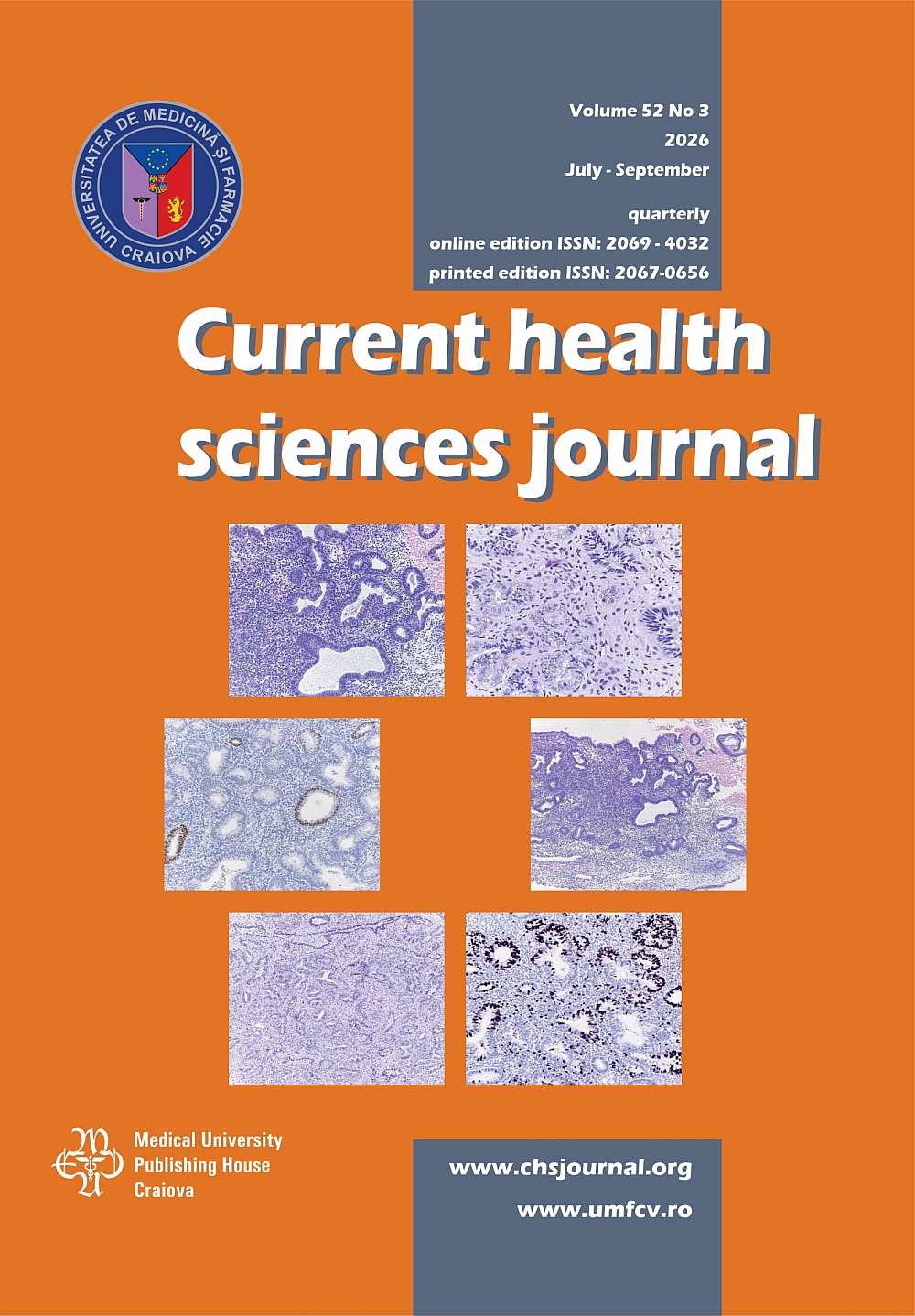 Download cover
Download contents
Journal archive
- vol. 52 no. 2, 2026
- vol. 52 no. 1, 2026
- vol. 51 no. 4, 2025
- vol. 51 no. 3, 2025
- vol. 51 no. 2, 2025
- vol. 51 no. 1, 2025
- vol. 50 no. 4, 2024
- vol. 50 no. 3, 2024
- vol. 50 no. 2, 2024
- vol. 50 no. 1, 2024
- vol. 49 no. 4, 2023
- vol. 49 no. 3, 2023
- vol. 49 no. 2, 2023
- vol. 49 no. 1, 2023
- vol. 48 no. 4, 2022
- vol. 48 no. 3, 2022
- vol. 48 no. 2, 2022
- vol. 48 no. 1, 2022
- vol. 47 no. 4, 2021
- vol. 47 no. 3, 2021
- vol. 47 no. 2, 2021
- vol. 47 no. 1, 2021
- vol. 46 no. 4, 2020
- vol. 46 no. 3, 2020
- vol. 46 no. 2, 2020
- vol. 46 no. 1, 2020
- vol. 45 no. 4, 2019
- vol. 45 no. 3, 2019
- vol. 45 no. 2, 2019
- vol. 45 no. 1, 2019
- vol. 44 no. 4, 2018
- vol. 44 no. 3, 2018
- vol. 44 no. 2, 2018
- vol. 44 no. 1, 2018
- vol. 43 no. 4, 2017
- vol. 43 no. 3, 2017
- vol. 43 no. 2, 2017
- vol. 43 no. 1, 2017
- vol. 42 no. 4, 2016
- vol. 42 no. 3, 2016
- vol. 42 no. 2, 2016
- vol. 42 no. 1, 2016
- vol. 41 no. 4, 2015
- vol. 41 no. 3, 2015
- vol. 41 no. 2, 2015
- vol. 41 no. 1, 2015
- vol. 40 no. 4, 2014
- vol. 40 no. 3, 2014
- vol. 40 no. 2, 2014
- vol. 40 no. 1, 2014
- vol. 39 no. 4, 2013
- vol. 39 no. 3, 2013
- vol. 39 no. 2, 2013
- vol. 39 no. 1, 2013
- vol. 38 no. 4, 2012
- vol. 38 no. 3, 2012
- vol. 38 no. 2, 2012
- vol. 38 no. 1, 2012
- vol. 37 no. 4, 2011
- vol. 37 no. 3, 2011
- vol. 37 no. 2, 2011
- vol. 37 no. 1, 2011
- vol. 36 no. 4, 2010
- vol. 36 no. 3, 2010
- vol. 36 no. 2, 2010
- vol. 36 no. 1, 2010
- vol. 35 no. 4, 2009
- vol. 35 no. 3, 2009
- vol. 35 no. 2, 2009
- vol. 35 no. 1, 2009